In this blog post, we will cover how self-employed solo S corporation owners can enhance their retirement savings through a self-employed pension (SEP) individual retirement account (IRA) (SEP IRA).
As a self-employed person, retirement takes a bit more planning than it did by simply signing up for your W-2 employer’s 401k plan. The good news is that while your retirement may take a little bit more work up front, you can sock away much more money for your retirement in general, as compared to a W-2 employee. And while there are more decisions to make up front to determine which plan is best for you as self-employed, setting up, contributing and reporting your contributions can be surprisingly easy.
Aside from a SEP IRA, some of the common options for self-employed retirement plans for S corporation small businesses are:
- Traditional or Roth IRAs;
- SIMPLE IRAs; and
- Solo 401ks.
Traditional/Roth IRAs are available to anyone with earned income, subject to various limitations. Aside from the various limitations, the max contributions are relatively small and insignificant if your business is successful enough to provide a living for you.
A Savings Incentive Match Plan for Employees (SIMPLE) IRA is another form of IRA for self-employed business owners. While the SIMPLE IRA has a higher contribution limit than a traditional/Roth IRA, the annual contribution limit of $17,000 for those under 50 years old is less than the annual contribution limit of a 401k (which in 2026 is $24,500). A SIMPLE IRA is good for those with an employee or a few employees, to be able to offer your employees salary deferral into a retirement account without the 401k administration costs/headaches. The SIMPLE IRA has mandatory 2-3% employee contributions regardless of whether employees contribute to the plan.
A Solo 401k is probably the biggest competitor to the SEP IRA. It has high contribution limits and some other advantages over the SEP IRA. However, it has more complex compliance to administer, and thus compliance costs with a CPA or third party administrator.
Back to the SEP IRA: the setup of the plan is as easy as setting up a traditional or Roth IRA, which if you have not done one of those, it’s very easy. This makes the SEP IRA great to start out with. The SEP IRA is treated like a traditional IRA, in that income is taxed when pulled out of the account, and the account cannot be accessed without penalty until the beneficiary has reached age 59 ½.
The SEP IRA allows for essentially 25% of the W-2 income from the business, or 25% of the net earnings from self-employment to be contributed to the account, with a corresponding deduction for the same amount. A couple nuances with this are that if you are an S corporation, the wage you pay yourself on the W-2 determines that 25% amount limitation for the SEP IRA, so if you are paying a very low wage to yourself to save on self-employment tax, you are limiting your SEP IRA contributions. Conversely, if you are a single-member LLC owner filing your business taxes on your personal return, the max SEP IRA amount is 25% of your net income, with some adjustments. Here is an example:
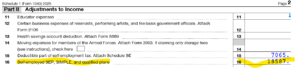
You are a single member LLC (no S corporation) with $100,000 net income. While you would think your max SEP IRA contribution would be $25,000, it’s actually $18,587. This is because the adjustments to the contribution you must make are:
- Take the deductible part of self-employment tax: $7,065
- Take ($100,000 – $7,065) = $92,935 multiplied by 20% reduced rate = $18,587
Your CPA, enrolled agent, or tax professional can tell you what your max contribution amount is, and then you must make the contribution to the plan by the due date of the tax return (including with extensions if you filed one).
In conclusion, SEP IRAs are a great way to save for retirement for self employed sole proprietors, single-member LLC owners or S corporation owners. Work with a licensed CPA, enrolled agent, or tax professional to assist you in helping implement your retirement plan.
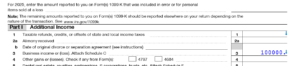
Self Employment Income from single-member LLC (no S corporation)